For homeschool families · Grades 5–12

You planned the education. We’ll carry the English — and the grading.

WritePath runs as a complete daily English language-arts spine:

  • the teaching,
  • the practice,
  • the assessment and the feedback

— and every piece of work lands in your inbox as it happens. You stay the educator. You stop being the grader.

First week free — no card. Start any Monday of the year.

The daily English program

How it works

How a WritePath week runs.

WritePath is not a pile of worksheets — it is a designed learning environment. Five kinds of work in a fixed weekly rhythm, one short module each weekday — and inside every module, the same closed loop: the teaching, the doing, the feedback.

Every week · five kinds of work

MONReading✓
TUEVocab✓
WEDGrammarTODAY
THUWriting
FRIPeer review

One short module a day — feedback to student & parent every time.


Every module · one closed loop

Effective learning DAILY LESSON Study the lessons Learn it TASK Active recall Apply it EMAIL Feedback Prove it

The weekly cycle, part by part

Five kinds of work — and why each one earns its place.

Each week moves through five module types. They look like five separate subjects. They are not — they are five contributions to one outcome: a student who can write clearly and think well. Here is why each one works.

Reading Comprehension

Builds: comprehension & models

A writer cannot produce prose they have never seen. Close reading of texts chosen for substance gives the student both genuine understanding and a working library of how strong writing behaves — the imaginative bandwidth every piece of writing draws on.
Vocabulary

Builds: the raw material

Ideas outrun language when a student does not have the words. Building academic vocabulary with full lexical depth — meaning, form, the words it works with — means the precise word is ready when the writing needs it, instead of being reached for and missed.

Grammar

Builds: technical precision

Clear writing is not a matter of talent. It is sentence and paragraph control — how a sentence holds together, how a paragraph signals its argument — and control can be taught, practiced, and made automatic so the student’s attention is free for the ideas.

Peer Assessment

Builds: editorial judgment

A student who can see what is weak in a sample piece of writing can begin to see it in their own. Assessing someone else’s work against a clear standard builds the internal editor — and students who have internalized what good looks like write better themselves.

Writing

Builds: the skill itself

Skill is built by doing the thing. Every week the student writes something real — a real purpose, a real audience, a real-world stimulus — and gets feedback that teaches. This is the practice the other four modules exist to feed.

The proof, not a promise

The grading, done — and in your inbox.

Marked against a teacher-written key, returned in minutes, and sent to you at the same moment. All thirteen screens are here — the question feedback, then the full writing review.

The opening & score

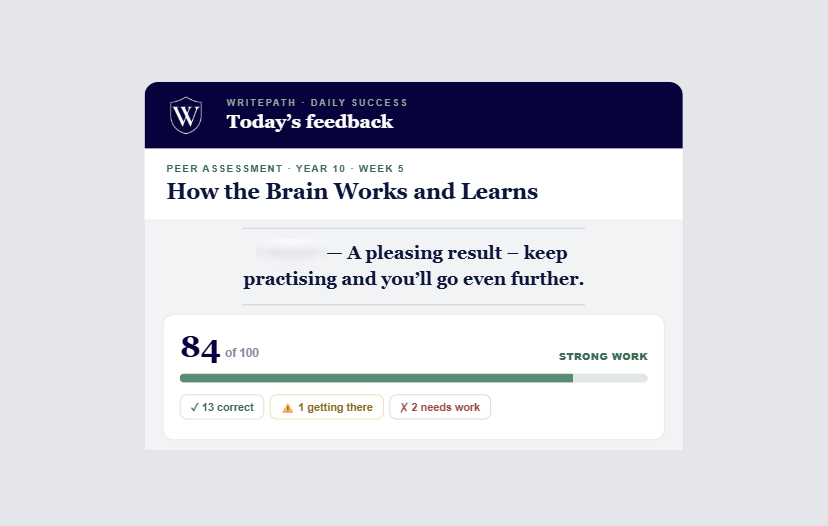
Feedback email header: the module title, a score of 84 out of 100 marked Strong work, and a one-line encouraging note.
The opening: module title, the score, and an encouraging note.

A right answer, explained

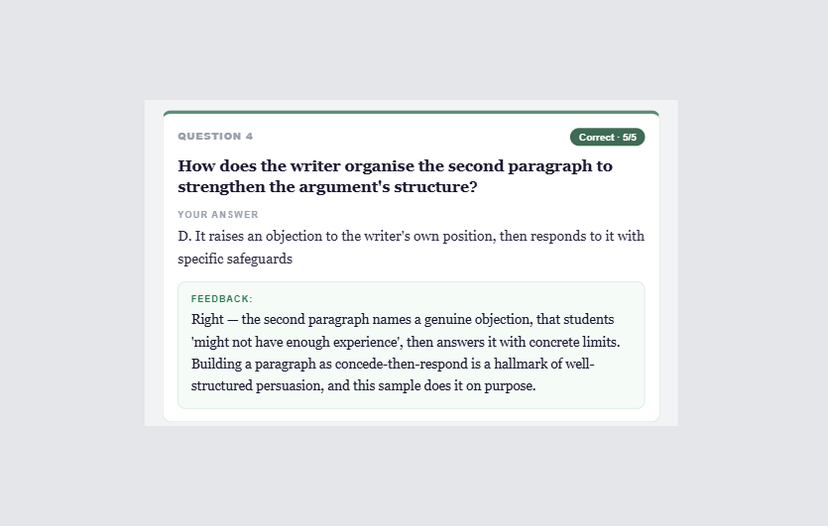
A correct multiple-choice answer marked 5 out of 5, with feedback explaining why the reasoning holds.
A right answer — and why the reasoning holds.

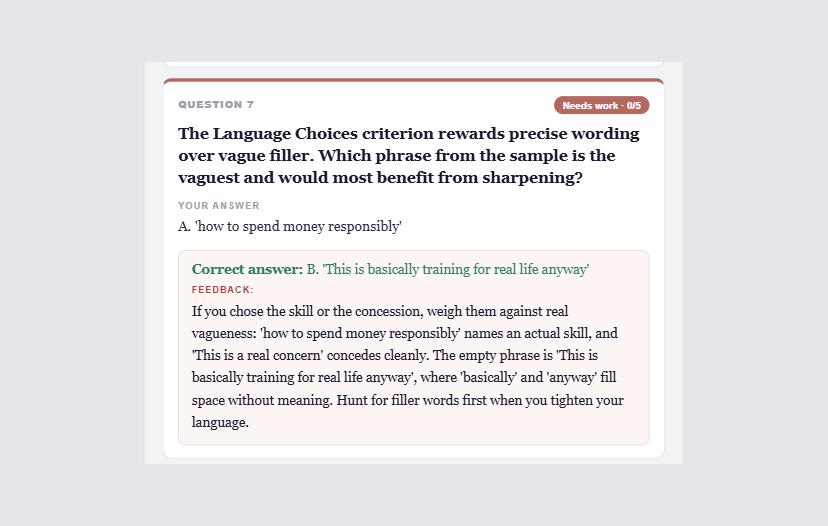
A wrong answer, and why

An incorrect multiple-choice answer showing the correct answer alongside feedback explaining the difference.
A wrong answer, shown against the right one, with the difference explained.

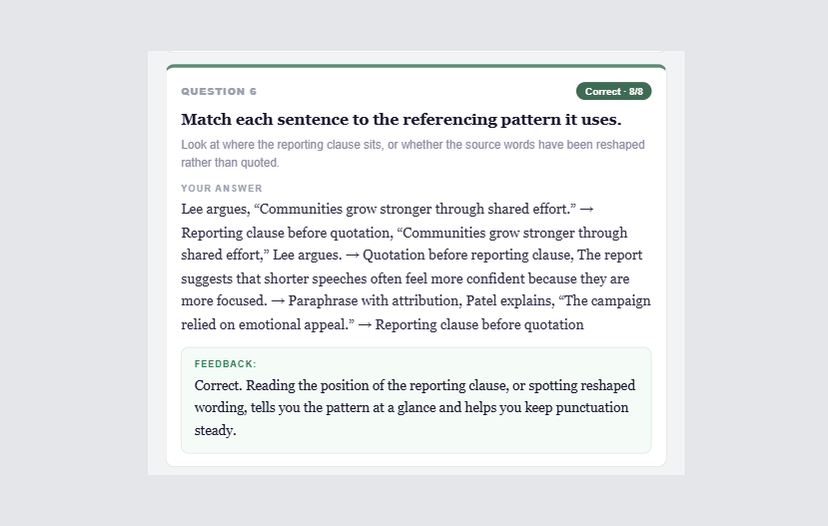
A matching task, marked

A matching question marked 8 out of 8, with feedback on what the pattern tells the student.
A matching task, marked — and what the pattern tells the student.

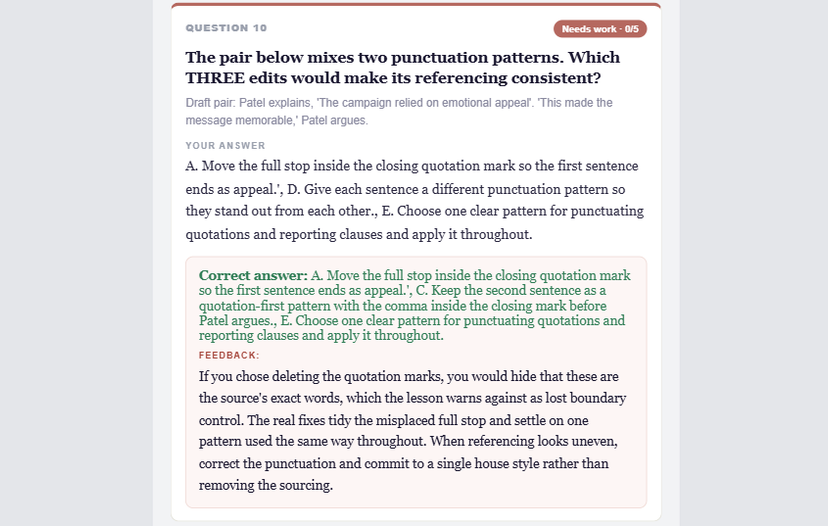
Multi-select, every option answered

A multiple-answer question marked as needing work, with the correct selection listed and each wrong choice addressed.
Every option answered, right and wrong.

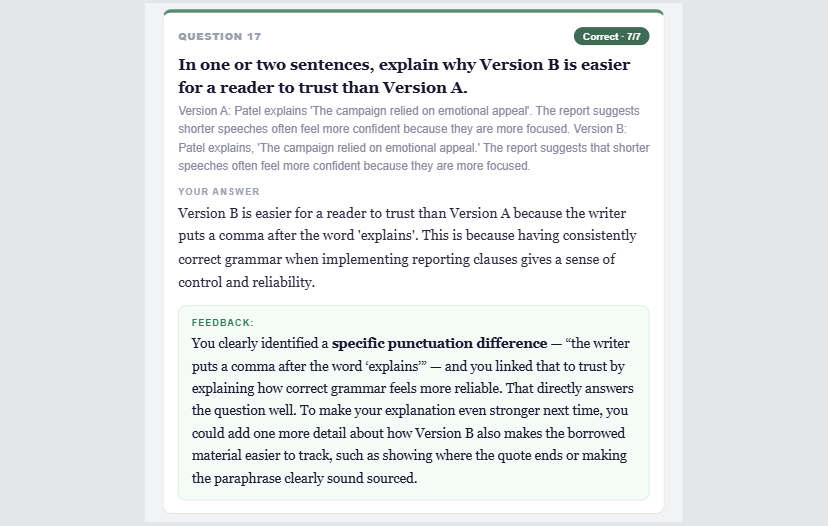
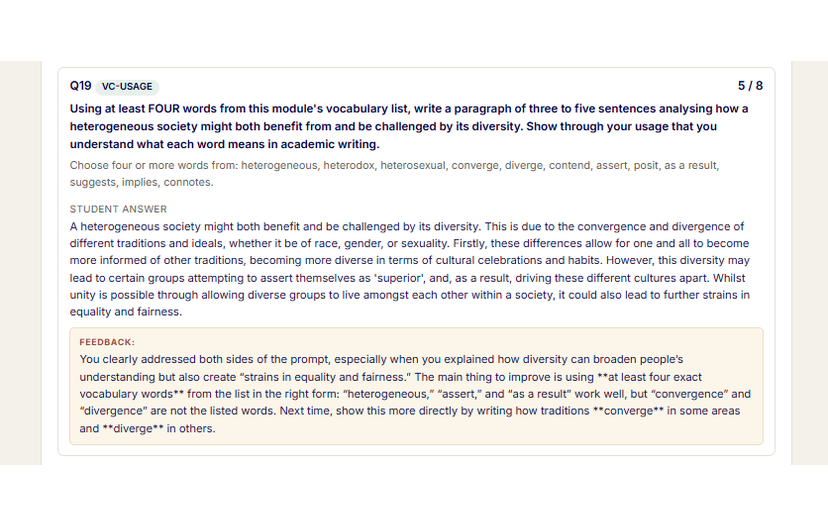
A written answer, marked in prose

A short written answer marked 7 out of 7, with several sentences of specific feedback on the student's reasoning.
Marked in prose, specific to the student’s reasoning.

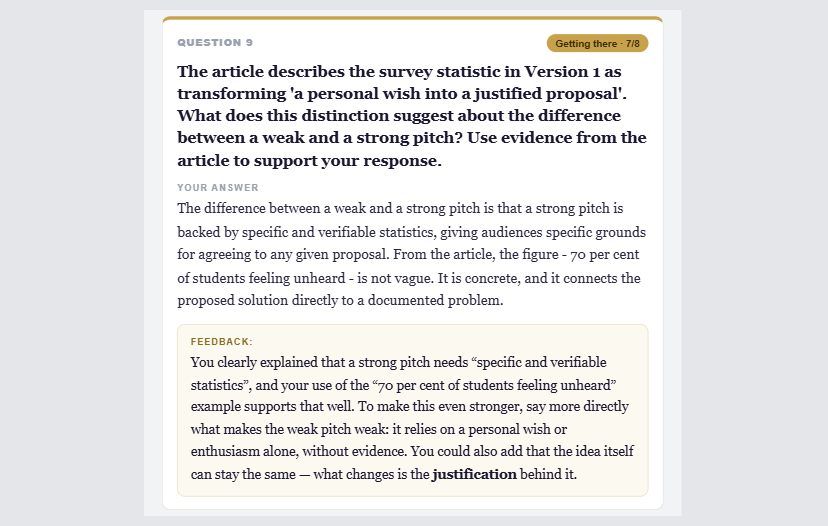
Partly there, and credited

A written answer marked Getting there at 7 out of 8, showing partial credit and what would lift it.
Partial credit earned — and exactly what would lift it.

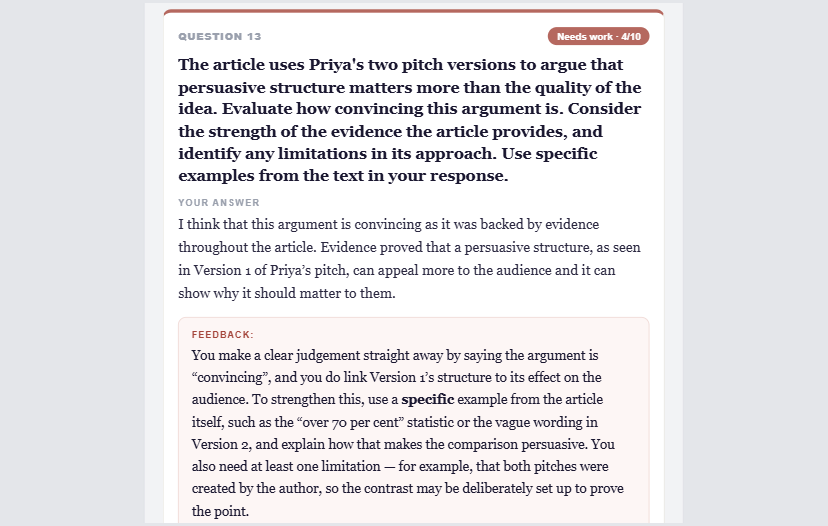
A weak answer, answered kindly

A written answer marked 4 out of 10, with constructive feedback naming exactly what to add next time.
A weak answer answered kindly: exactly what to add next time.

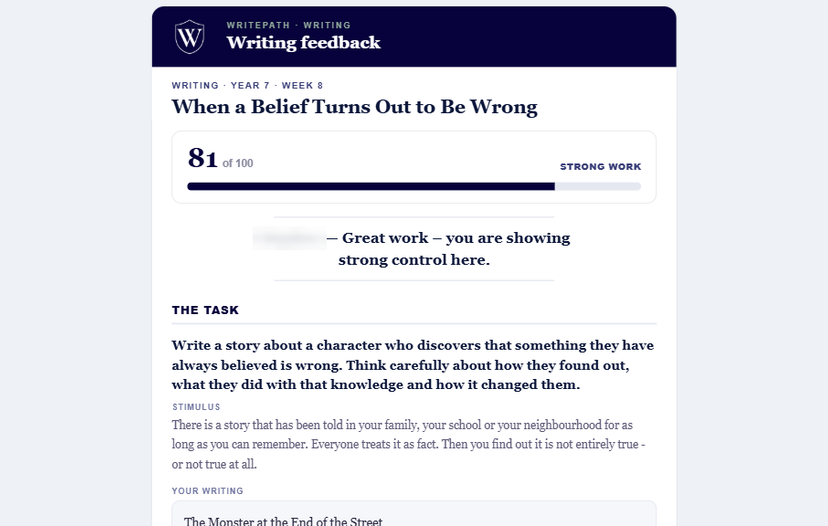
The writing review opens

Writing feedback email: the title, a score of 81 out of 100 marked Strong work, the task set, the stimulus and the student's own writing.
The task, the stimulus, the score — and your child’s own writing.

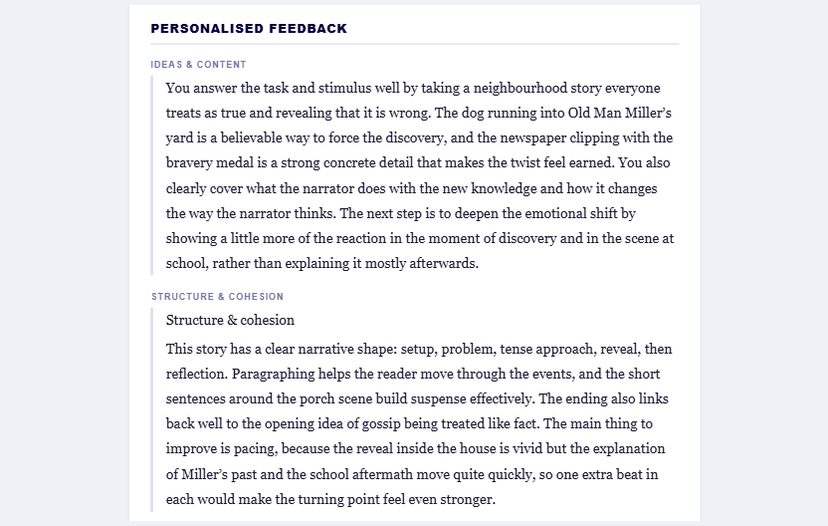
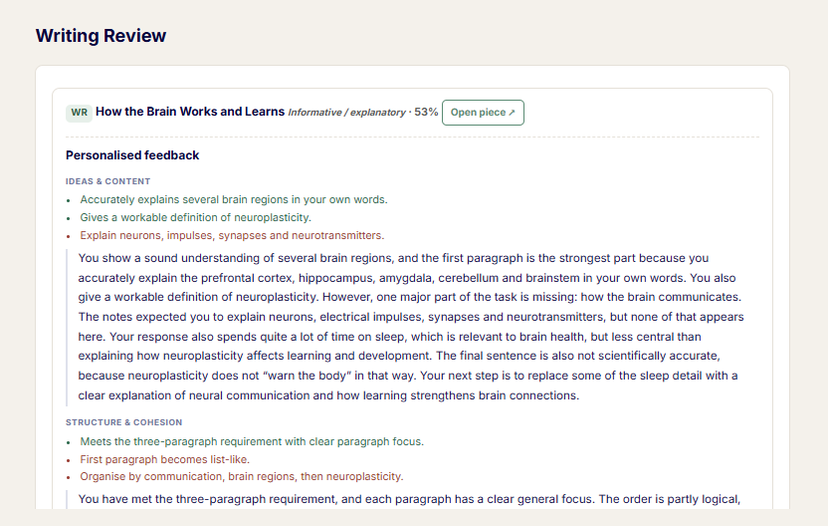
Ideas & structure

Personalized feedback on ideas and content, and on structure and cohesion, written as prose about this particular piece.
Prose feedback on ideas and structure, about this particular piece.

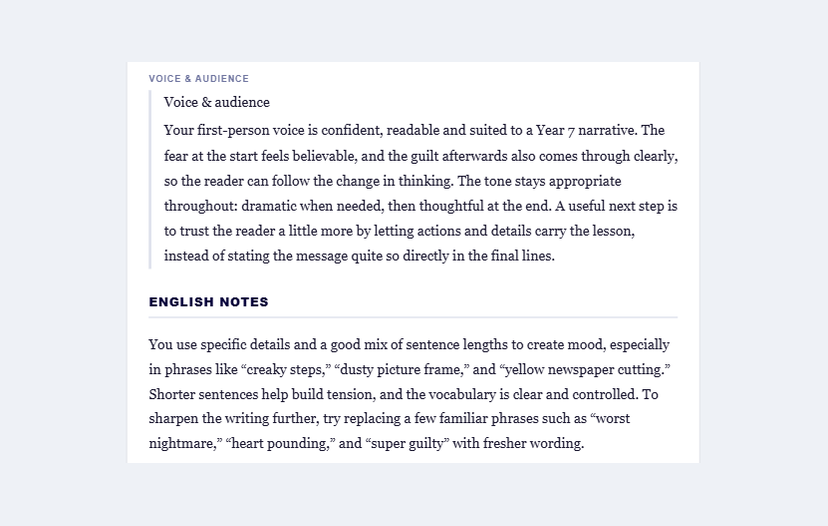
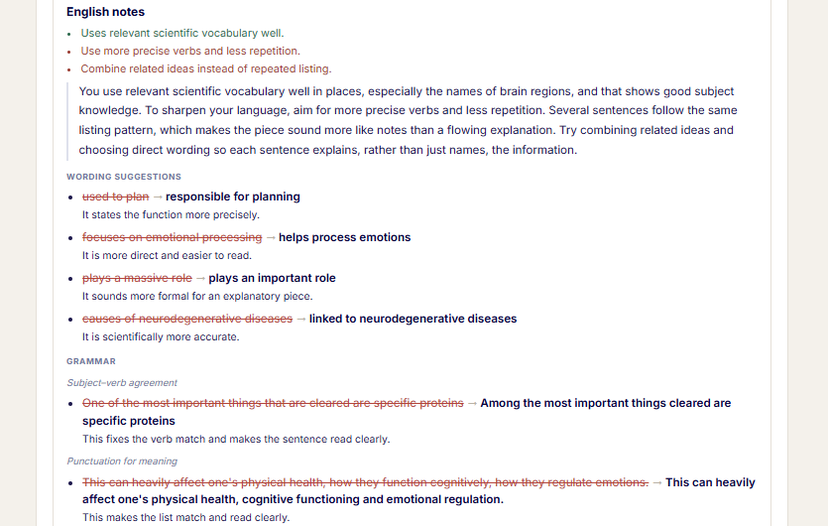
Voice, audience & English notes

Personalized feedback on voice and audience, followed by English notes on sentence length and word choice.
Voice and audience, then notes on sentence length and word choice.

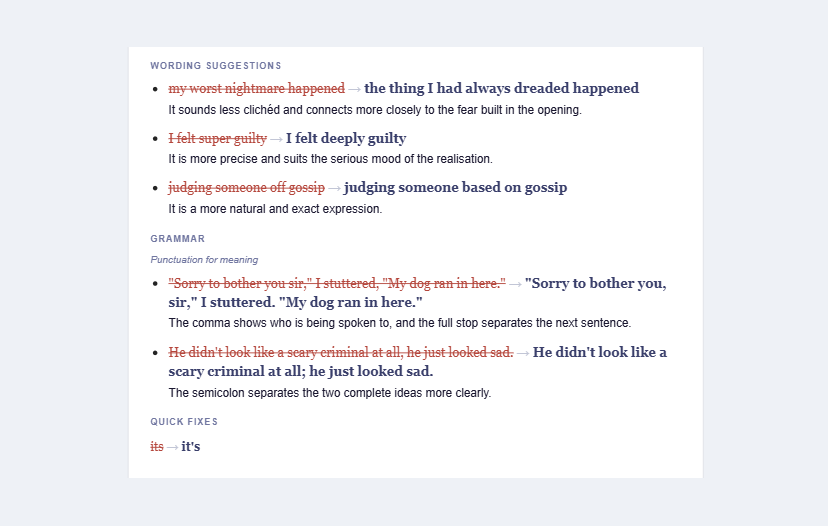
Line-by-line corrections

Wording suggestions, grammar corrections and quick fixes marked directly through the student's own sentences.
Line edits written through the sentences your child actually wrote.

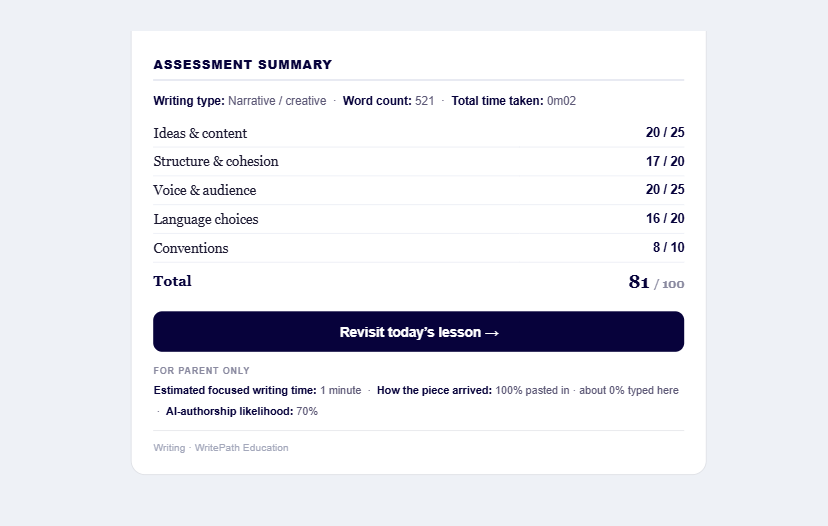
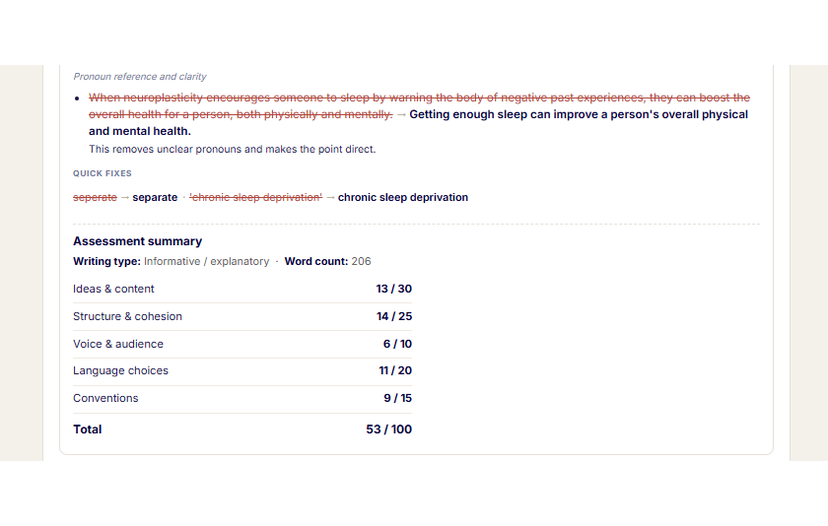
The assessment summary

The assessment summary: five criteria scored separately, totalling 81 out of 100.
Five criteria, scored separately — the summary that lands in your inbox.

Built on substance

A real curriculum — not a worksheet generator.

264 weekly cycles across the Foundations years (Grades 5–10)
92 article-based senior weeks, with 92 extended essays (Grades 11–12)
8 years one continuous program, every module sequenced into it

Developed by educators and taught to students every weekday — the reading, vocabulary, grammar and writing advancing together, year over year.

Educator Partner — for the parent who teaches

Are you an involved parent educator?

Optional · Free

We make your teaching easier — and more effective.

The free educator’s toolkit, for the parent who teaches. Set WritePath Daily Success as the daily English work, and everything we built for professional tutors is yours: a dashboard view of how your child is really performing, and teaching material generated on the spot from their own answers.

Optional  ·  Free, with no conditions  ·  One educator per child  ·  Never changes your price

Step 1

WritePath

Daily Success

Daily weekday homework

Step 2


AI analyses every answer

Your dashboard

Step 3


Tailored lesson material

Produced on the spot

What you receive

Everything a professional tutor gets. Free.

If you are the parent who teaches, register as an Educator Partner and link yourself to your own child — the whole toolkit is yours, at no cost:

  • A report on the period since you last sat down together — every module completed, by date, with the score, and which kind of work is carrying the weakness.
  • Everything, question by question — written answers in full, and every piece of writing as the complete marked-up report your family received.
  • Teaching Priorities — two to four things worth teaching next, found by reading every wrong answer in the period and naming the pattern behind them.
  • Lessons generated on the spot — about fifteen minutes of teaching material for each priority, with the first worked example built from your child’s own answer.
  • What is coming next — the modules your child is about to meet, so you can prepare the week ahead as well as review the one behind.
Also included: five family referral codes

Five single-use codes, each 25% off a yearly plan — to give to other families you know. They are for other families, never for your own plan.

Simply register as an Educator Partner and add yourself as your child’s educator. One educator per child; linking never changes a family’s price.

Your dashboard

Your child’s English, in full view.

One report, run whenever you choose — here is what it gives you, screen by screen.

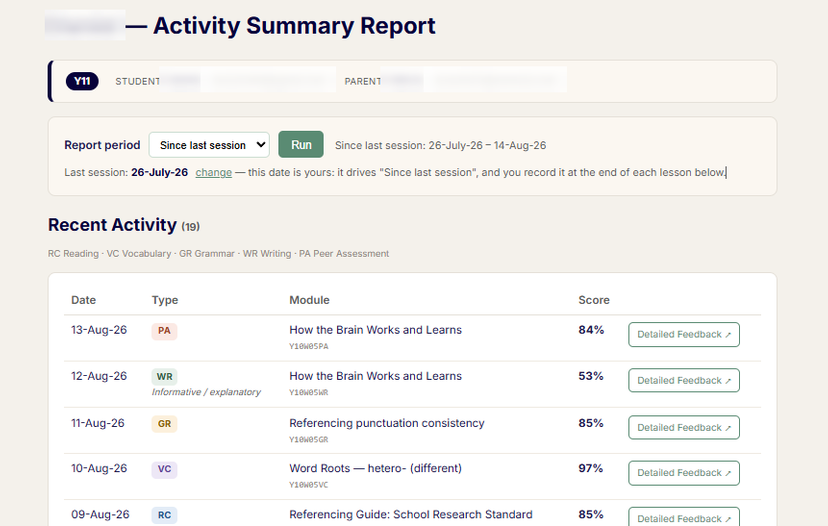
Recent activity

The opened report showing recent activity: every module completed, with date, type, title and score.
Every module they completed since you last met, by date, with the score and a link to the full detail.

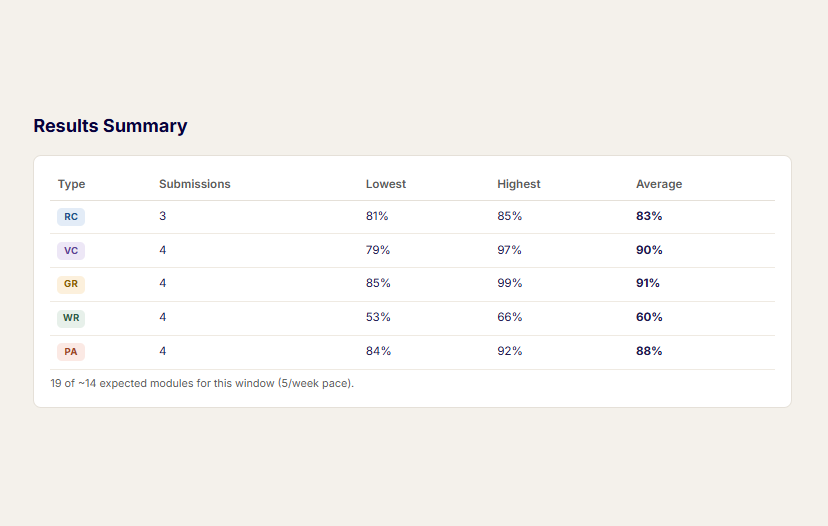
Results summary

A results summary table by module type, showing submissions, lowest, highest and average scores.
The shape of the period at a glance — and which module type is carrying the weakness.

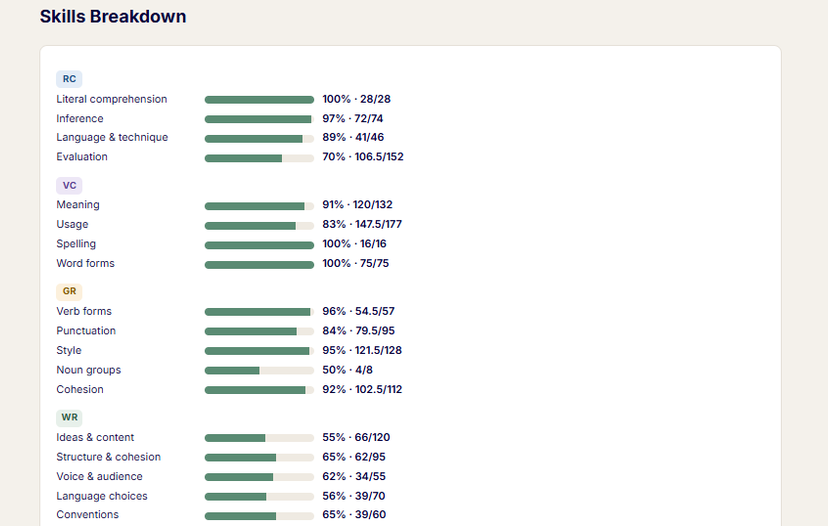
Skills breakdown

A skills breakdown with a percentage bar for every strand across all five module types.
Strand by strand, with the raw counts behind each percentage.

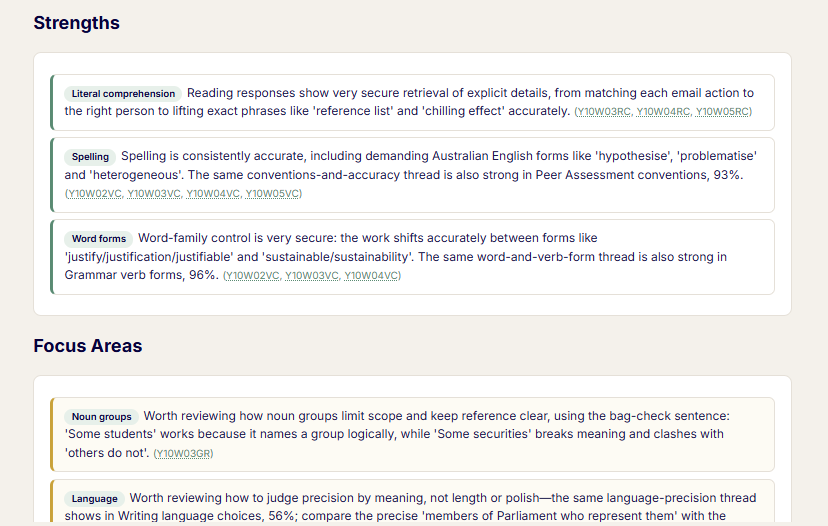
Strengths and focus areas

Strengths and focus areas, each written out with the module references that evidence it.
Every claim carries the module codes it came from, so you can check it.

The full detail, question by question

Detailed feedback for a module: each question, the student's answer, the correct answer and the marker's feedback.
Nothing is summarized away. If you want question seven, question seven is there.

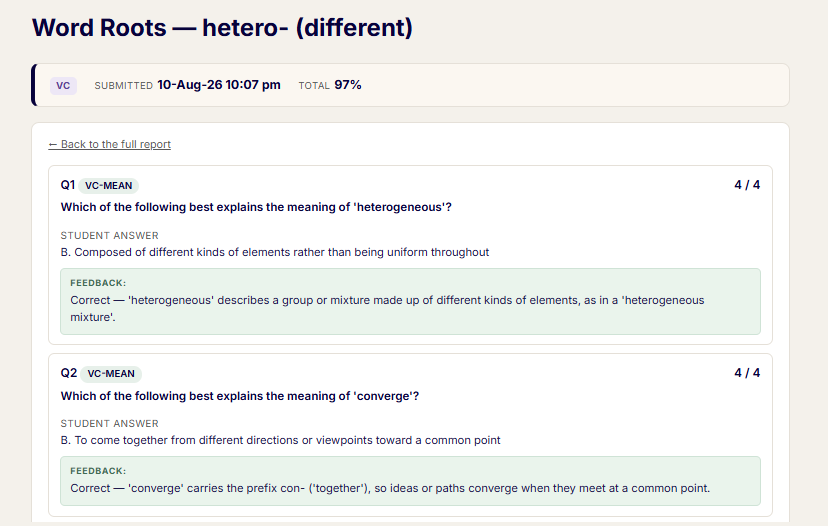
A written answer in full

A written vocabulary answer shown in full with the marker's feedback beneath it.
Written answers appear complete — their words, then the marking.

Writing, reviewed in full

A writing review: personalised feedback on ideas and content and on structure and cohesion.
The writing task opens as the complete mark-up, not a score.

English notes and suggestions

English notes, wording suggestions and grammar corrections marked through the student's own sentences.
The corrections run through their own sentences — you can see where it came apart.

Quick fixes and the summary

Quick fixes, and the assessment summary scoring five criteria to a total.
It ends on the same five criteria the family sees, so you are both looking at one thing.

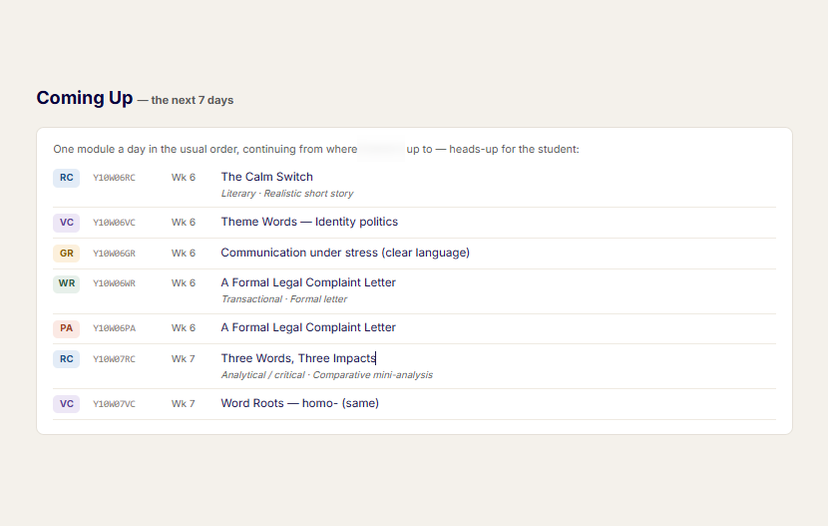
What is coming next

A Coming Up list of the modules scheduled for the next seven days.
So you can set the session against what they are about to meet, not only what they have done.

A session day, in three steps

See it. Open it. Teach it.

When you sit down with your child, the preparation is already done: see what needs attention, open the lesson built from their answers, and teach it together.

1 · See what needs attention

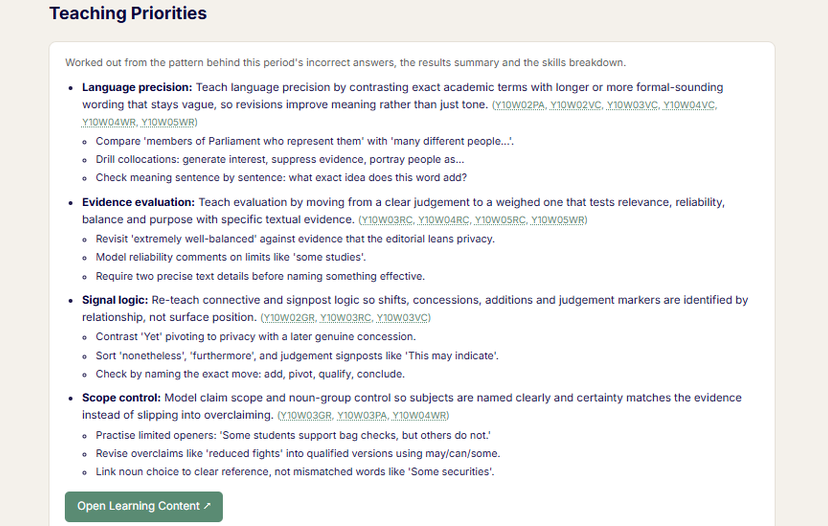
Teaching Priorities

Teaching priorities worked out from the period's incorrect answers, each with the evidence behind it.
Worked out from the pattern behind this period’s wrong answers — not from a template.

2-a · Open the lesson built from their answers

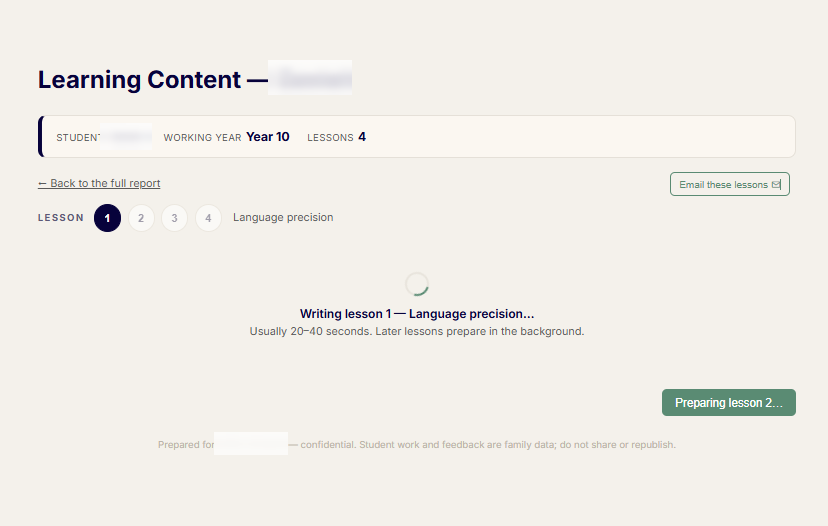
It writes the lesson

The lesson preparing on screen, showing lesson one of four being written.
Usually twenty to forty seconds. The later lessons build in the background while you read the first.

2-b · Open the lesson built from their answers

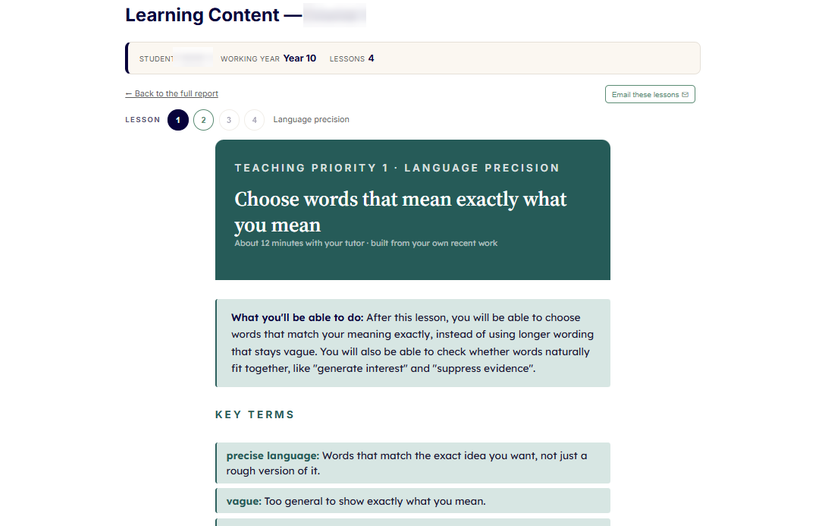
The lesson opens

The top of a prepared lesson: the teaching priority, what the student will be able to do, and the key terms.
It opens on the priority, what they will be able to do, and the words they need.

3-a · Teach it together

Explained from the ground up

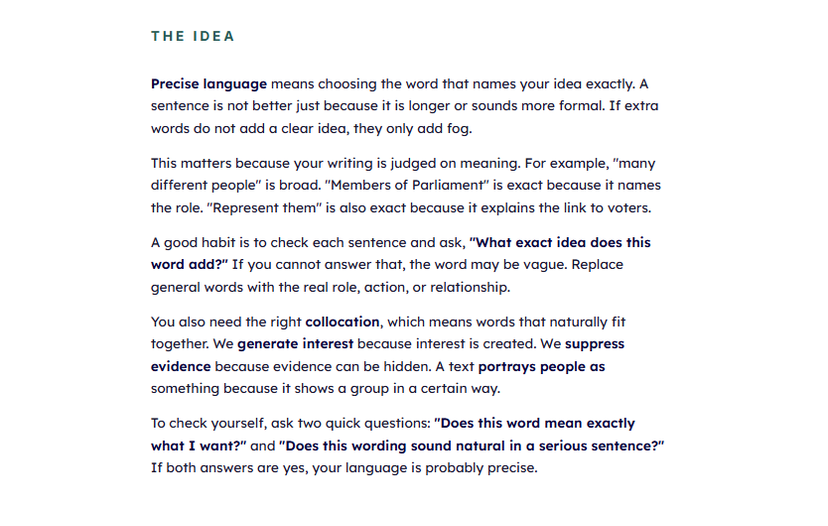
The idea explained in full prose, building the concept from first principles rather than restating the rule.
The concept is built, not restated — so you can teach it rather than read it out.

3-b · Teach it together

Worked from their own answer

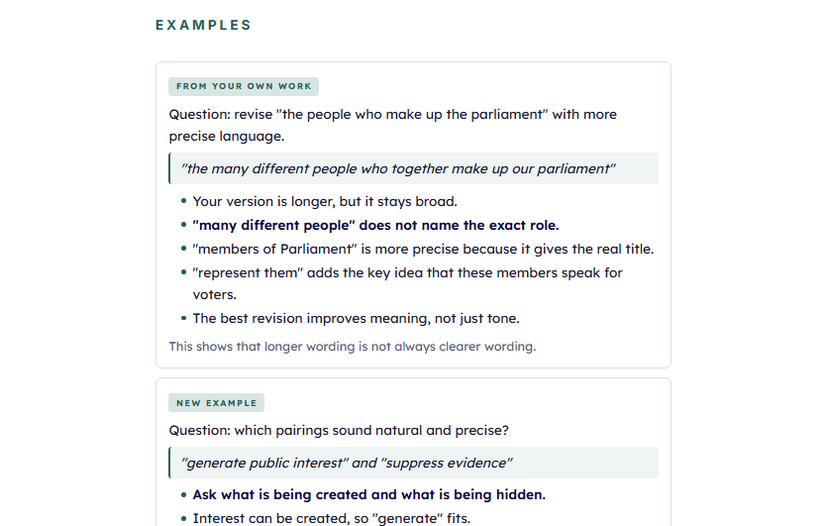
Worked examples: the student's own answer revised, followed by a fresh example of the same skill.
One example is their own work, improved. The next is new, so they have to transfer the skill.

3-c · Teach it together

A check to do together

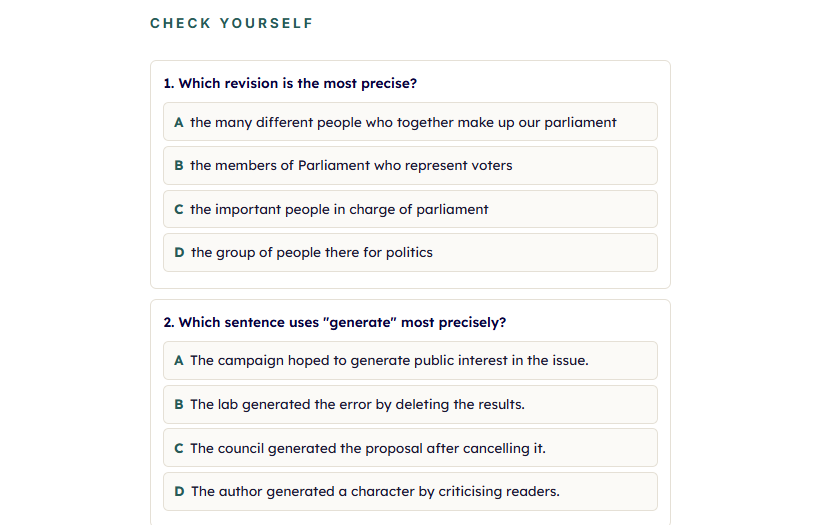
A short check-yourself quiz on the skill just taught.
Short enough to do in the session, and it tells you straight away whether it landed.

3-d · Teach it together

Marked on the spot

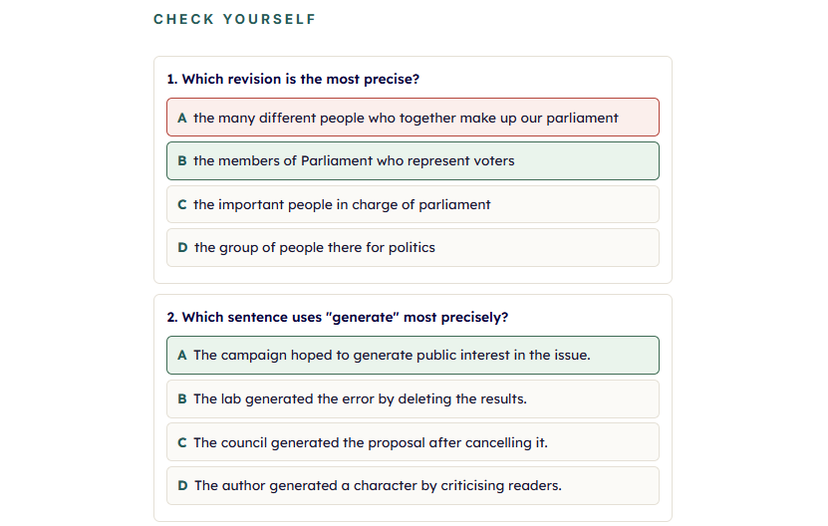
The same quiz marked, with correct answers confirmed and wrong ones shown against the right one.
Marked in front of them, so the correction happens while it still matters.

Beyond English

English for school. Learning for life.

Sooner or later, you’ll notice what the reading is really about.

A new way to look at a problem. A better understanding of another person. An idea that helps them make sense of the world. WritePath brings that wider learning into the same reading and writing that build your child’s English skills.

A world rising from the pages of an open book: two students talking on a path that winds through trees, town buildings, a bridge and a coastline.

Across the years, your child explores how to:

  • Say what they mean, understand other people and work through disagreements.
  • Think about what is right and take responsibility for their choices.
  • Understand how money works and how decisions affect their community.
  • Think for themselves and make decisions they can explain.

Learning beyond English · Grades 5–10

The skills to handle life. The mindset to keep growing.

Across Grades 5–10, 509 of our 528 Reading and Writing modules include learning beyond English. Explore a selection below, grouped into five themes.

Communication & emotional intelligence

Express themselves clearly, understand others and work through disagreements.

Not a Debate, a Check-In (Grade 7, Reading)

How to tell a friend that something hurt while leaving room to repair the relationship.

  • Disagreeing Without Contempt (Grade 9, Reading)
  • Two Different Ways of Apologizing (Grade 8, Writing)
  • When the Apology Is Not Enough (Grade 10, Writing)
  • That’s Not Funny Anymore (Grade 6, Reading)
  • Helping Someone Who Does Not Want Help (Grade 8, Writing)
  • Three Tones, One Chat Thread (Grade 8, Reading)
  • The Lunch Table Line (Grade 5, Reading)
  • Low Battery, Clear Boundary (Grade 8, Reading)
  • How My Friendship Group Really Works (Grade 8, Writing)

Critical thinking & judgment

Check what they hear and read, recognize influence and form considered views.

True Numbers, Twisted Message (Grade 9, Reading)

How accurate statistics can still mislead through missing context and selective comparisons.

  • Why Your Feed Knows You (Grade 7, Reading)
  • Spot the Tilt (Grade 6, Reading)
  • What Makes an Expert? (Grade 9, Reading)
  • Why Crowds Change People (Grade 8, Reading)
  • A Common Belief I Think Is Wrong (Grade 10, Writing)
  • Why Corrections Don’t Stick (Grade 9, Reading)
  • Should Students Use AI Writing Tools for Assignments? (Grade 8, Writing)
  • When a Belief Turns Out to Be Wrong (Grade 7, Writing)
  • Reliability Review: Can We Trust This? (Grade 8, Reading)

Self-management

Manage feelings, build useful habits and keep going when learning gets difficult.

The Behavior Gap: Why Intentions Fail (Grade 9, Reading)

Why good intentions can fall short — and how changing routines and surroundings can help.

  • The Talent Story Isn’t the Whole Story (Grade 7, Reading)
  • Before It Boils Over (Grade 6, Reading)
  • The Two-Minute Start (Grade 5, Reading)
  • The Science of Distraction (Grade 6, Reading)
  • The Feedback Moment (Grade 8, Reading)
  • Managing Multiple Deadlines (Grade 8, Writing)
  • Why We Forget (Sometimes) (Grade 5, Reading)
  • Two Ways of Handling Difficulty (Grade 6, Writing)
  • Case Study: The Phone-Off Block (Grade 10, Reading)

Character & ethics

Consider what is right, how choices affect others and how to take responsibility.

Two Definitions of Loyalty (Grade 9, Writing)

When does standing by a friend become covering for dishonesty or harm?

  • The Choice No One Will See (Grade 9, Writing)
  • The Time I Stayed Silent (Grade 6, Writing)
  • The Good Deed No One Knew About (Grade 8, Writing)
  • Legal, Ethical, Both, Neither? (Grade 10, Reading)
  • When I Acted Against My Values (Grade 9, Writing)
  • The Mistake I Had to Face (Grade 5, Writing)
  • No Excuses, Just Change (Grade 10, Reading)
  • Our Fair Turn Plan (Grade 6, Reading)
  • Where Moral Obligation Comes From (Grade 10, Writing)

Civic & economic understanding

Understand money, public decisions and how everyday choices affect the wider world.

The True Cost of Fast Fashion (Grade 8, Reading)

What a cheap piece of clothing can cost beyond its price tag.

  • Should Students Control Part of the School Budget? (Grade 9, Writing)
  • Automation: Jobs, Skills, Inequality (Grade 10, Reading)
  • Case Study: The Saving Choice (Grade 6, Reading)
  • Should Products Be Designed to Be Repaired? (Grade 8, Writing)
  • What Inflation Is (Grade 8, Writing)
  • The Gig Economy and Its Effects (Grade 10, Writing)
  • Fair Isn’t Always Equal (Grade 5, Reading)
  • How a Bill Becomes a Law (Grade 9, Writing)
  • How American Federal Elections Work (Grade 10, Writing)

Your child follows the curriculum for their grade level. Familiar situations in the younger years develop into more demanding questions as they grow.

Learning beyond English · Grades 11–12

For the decisions, relationships and responsibilities ahead.

You want your child to leave school able to think independently, manage themselves and make thoughtful choices about their future.

In the senior years, Learning beyond English explores the questions behind that independence: how to learn, who to trust, what to do with money, how to handle relationships and what kind of person to become.

Across 92 substantial articles and 92 extended essay tasks, students examine evidence, consider competing arguments and develop positions they can explain. Here is a selection of the ideas they encounter.

Learning, focus & habits

Understand how they learn, protect their attention and build habits they can sustain.

How habits actually form

Why lasting habits depend on repeated actions and everyday surroundings — and how to make a useful habit easier to keep.

  • The learning-styles myth
  • The multitasking story
  • Sleep as learning
  • Your environment makes most of your decisions
  • Deep work as competitive advantage
  • Testing as learning, not measurement

Understanding themselves & handling pressure

Recognize what they are feeling, respond to pressure and make room for recovery.

The brain still being built

An exploration of teenage emotions, peer influence and developing judgment, giving students another way to understand their own reactions.

  • Good stress, bad stress
  • Being kind to yourself
  • The vocabulary of feeling
  • What athletes know about recovery
  • Why movement changes mood
  • Deciding who you are, too early

Relationships & communication

Listen well, handle conflict and ask for what they need with care and confidence.

Negotiation as design

How to understand what both sides need, prepare a clear request and work towards an agreement — whether discussing a first salary, a rental or a major purchase.

  • What listening actually looks like
  • Repairing after fights
  • Trust, betrayal and the logic of reciprocity
  • Four moves that disarm a conversation
  • The six levers of persuasion
  • Money and love

Decisions & judgment

Weigh risks, question their first reaction and think clearly when the answer is uncertain.

The two systems in your head

An introduction to fast, intuitive reactions and slower, deliberate thinking — and why feeling certain can be a reason to look more closely.

  • The illusion of knowing
  • Confidence and competence on different roads
  • Why losing hurts twice as much as winning feels good
  • Reversible vs. irreversible
  • When to quit
  • Regret minimization

Money, work & the future

Examine their beliefs about money, recognize trade-offs and think carefully about success.

The money stories you inherited

How family experiences shape beliefs about spending, saving and success — and what becomes possible when those beliefs are brought into view.

  • Lifestyle creep
  • The “follow your passion” problem
  • The work of the future
  • Opportunity cost, and why economists think differently
  • Inflation, and why it’s harder than it sounds
  • Timing, talent, and the luck question

AI, information & society

Use technology thoughtfully, assess information and understand decisions that affect their lives.

Thinking with AI vs. thinking because of AI

Students weigh useful assistance against the thinking they need to do for themselves, then put that judgment to work by proposing a school AI policy.

  • Your teenage self, preserved forever
  • The misinformation problem
  • Evaluating information, seriously
  • Machines making decisions about people
  • What democracy actually needs
  • Voting, and what it doesn’t tell you

Character, leadership & a meaningful life

Take responsibility, understand their influence and consider what matters beyond achievement.

Situation beats character

Why circumstances can pull people away from their values — and how recognizing those pressures can inform their choices and their understanding of others.

  • Why we all think we’re the good guy
  • The honest experiment on honesty
  • Courage as an everyday decision
  • The humble leader
  • Enough, the quiet question
  • What people really regret at the end

These questions give students something substantial to think and write about as they develop the extended writing senior study demands — and consider the life they want to build beyond school.

Try it right now

Get instant access to our learning content, quizzes and feedback.

No sign-up for these. Open your child’s grade below and pick any module — real modules from across the year, exactly as a member sees them: the teaching, the task, the submission and the feedback.

Grade 5Five modules · one of each type+
Module typeTitle
Reading ComprehensionFeelings FinderOpen
VocabularyTheme Words — Feelings & emotionsOpen
GrammarApostrophes 1 (contractions vs possession)Open
WritingChoosing What Is RightOpen
Peer AssessmentChoosing What Is RightOpen
Grade 6Five modules · one of each type+
Module typeTitle
Reading ComprehensionWhy Sleep WinsOpen
VocabularyWord Roots — -path- (feeling / suffering)Open
GrammarCommas for clarity (advanced patterns)Open
WritingShould Financial Literacy Be a School Subject?Open
Peer AssessmentShould Financial Literacy Be a School Subject?Open
Grade 7Five modules · one of each type+
Module typeTitle
Reading ComprehensionThe Algorithm Behind YouOpen
VocabularyTheme Words — Mental healthOpen
GrammarCounter-argument and rebuttal sentencesOpen
WritingWhen a Belief Turns Out to Be WrongOpen
Peer AssessmentWhen a Belief Turns Out to Be WrongOpen
Grade 8Five modules · one of each type+
Module typeTitle
Reading ComprehensionFast Fashion FalloutOpen
VocabularyWord Roots — -sens / -sent- (feel / think)Open
GrammarRegister shifts (formal vs informal patterns)Open
WritingShould Students Use AI Writing Tools for Assignments?Open
Peer AssessmentShould Students Use AI Writing Tools for Assignments?Open
Grade 9Five modules · one of each type+
Module typeTitle
Reading ComprehensionValues Clash CalmOpen
VocabularyTheme Words — Artificial intelligence & ethicsOpen
GrammarProfessional writing (emails and requests)Open
WritingWhat Stress Does to the BodyOpen
Peer AssessmentWhat Stress Does to the BodyOpen
Grade 10Five modules · one of each type+
Module typeTitle
Reading ComprehensionSteelman Then RespondOpen
VocabularyWord Roots — -ver / -veri- (truth / true)Open
GrammarClaims with limits (anti-hype)Open
WritingShould Standardized Tests Be Abolished as the Main Pathway?Open
Peer AssessmentShould Standardized Tests Be Abolished as the Main Pathway?Open
Grade 11Three modules · Applications+
Module typeTitle
Reading ComprehensionThe dopamine loop, clearlyOpen
VocabularyThe dopamine loop, clearlyOpen
WritingThe dopamine loop, clearlyOpen

In Applications (Grades 11–12) the three tracks fuse around one substantial article each week — which is why all three modules here share a title.

Grade 12Three modules · Applications+
Module typeTitle
Reading ComprehensionDeep work as competitive advantageOpen
VocabularyDeep work as competitive advantageOpen
WritingDeep work as competitive advantageOpen

In Applications (Grades 11–12) the three tracks fuse around one substantial article each week — which is why all three modules here share a title.

Frequently asked questions

How it fits, day to day.

Straight answers — and a real person behind them.

Is WritePath a complete homeschool English curriculum? +

Yes. It provides the curriculum, teaching, practice and assessment for Grades 5 to 12. Grades 5–10 include Reading Comprehension, Vocabulary, Grammar, Writing and Peer Assessment each week; Grades 11 and 12 concentrate Reading, Vocabulary and extended Writing around one substantial article each week.

WritePath is a single-subject program built for depth. It does not provide math, science or a complete all-subject package.

Does a parent need to be an English specialist? +

No. Each module teaches the skill before asking the student to apply it — the program supplies the reading, explanation, examples, task and feedback.

The educator tools help a homeschooling parent see patterns and decide where their teaching time is most useful. AI-generated lesson material should be reviewed by the parent before it is taught.

How much time does it take each day? +

One module a weekday. The time a module takes varies a great deal — by grade level, by module type, and by the student. Each module has a defined start and finish, so your child works through one piece of work and stops, rather than working to a clock. A senior week is three sessions built around that week’s article.

My child is already strong at English — or really struggles. Does this still fit? +

Both, because the program is sequenced by grade level rather than pitched at one ability. A strong writer gets work at the top of their grade’s expectations and feedback specific enough to actually move them — the thing bright students most often go without. A struggling writer gets the same week broken into one finishable piece a day, which is usually the real problem: not capability, but nothing ever being completed.

If you are not sure where your child sits, our free tests will tell you: the English Competence Test measures reading, vocabulary and grammar against their own grade’s expectations, and the Writing test does the same for one piece of their writing.

How do I choose the right level? +

Start at our free test page. The English Competence Test measures reading comprehension, vocabulary, and grammar and conventions against grade-level expectations (Grades 5–10). The Writing Skill Level Test assesses one piece of your child’s writing against the same rubric used in the program, and also serves as a placement tool whatever grade label your family uses.

Each comes with a written report; sitting both gives you the complete picture of where your child sits, and where to start.

Can I change my child’s grade level later? +

Yes, any time, from My Account. It matters more than people expect: the grade level decides which week of material your child is served, so if you started them a grade out, moving it puts them straight onto the right work.

How does WritePath use AI? +

AI assists in two parts of the program. First, content production, within editorially designed curriculum frameworks: the program architecture, learning objectives, sequence, theme balance, writing criteria and research-informed counterarguments are human design decisions. Second, assessment: closed questions are scored exactly, open answers are assessed against teacher-authored marking keys, and writing is assessed against WritePath’s five-domain rubric, weightings and marking instructions. This is what makes detailed, individual feedback possible within minutes.

WritePath sets the standard. The AI applies it. The student does the thinking and writing — AI does not generate answers for the student. A child’s work is not used to train AI models.

Is the curriculum secular? +

Yes. WritePath is secular and research-based and takes no religious position.

The older grades discuss mature questions — including relationships, consent, identity, moral disagreement and assisted dying as a debate topic. They are subjects for careful thought rather than instruction. Families should consider whether that approach fits their homeschool.

Can I use the feedback emails for homeschool records? +

The emails provide dated, assessed work — the response, the scores and the feedback — and families can draw on them for portfolios, logs and progress reporting. Requirements vary by state, so check the rules that apply to your family; WritePath does not claim that its records alone satisfy every jurisdiction.

If you register as your child’s Educator Partner (free), the dashboard adds to this: set the report period to the month just gone and it prepares an Activity Summary report of everything completed in it.

I’ve subscribed — how do I register my child? +

It takes about a minute. You add each child with just their name, grade level and an email — a Gmail lets them sign in with one tap, any other email works with a quick emailed code (no password to remember). From My Account you stay in control: change a child’s grade level anytime, update the feedback email where reports are sent, review your billing, and open each child’s My Learning to see their weekly modules, recent scores and what’s coming next.

How does my child sign in? Is there a password? +

No password, on purpose — forgotten passwords are the single most common reason a child stops doing something online. If their email is a Gmail, they sign in with one tap. Any other email works too: they enter the address, a code arrives, they type it in. There is no app to install either — it runs in a browser on whatever they already use.

How do I cancel — and when does it stop? +

Anytime, from My Account — no phone call, no waiting. Your plan stops renewing, and you keep access until the end of the period you’ve already paid for. You’ll always see your next billing date before you’re charged.

Can I get a refund? +

Yes — in the first 30 days. If it isn’t right for your child, open My Account, cancel the membership, then use the Request refund button beside it. We refund what you have paid in full, you don’t need to give a reason, and the promise is available once per family.

After that, we don’t refund a change of mind mid-period — but you can cancel anytime and keep access to the end of the period you have paid for, so there is nothing to be stuck in.

What it costs

Simple pricing.

Daily Success is US$27 a month for one child — every weekday module, all the marking and feedback, and the full parent record. Siblings join the same plan for US$8 a month each, and the first week is free. Every plan carries a 30-day full-refund policy.

See plans, yearly prices and what’s included →

Start with where they are

Start with where your child’s English actually is.

The free English Competence Test measures reading, vocabulary and grammar, and the free Writing test assesses one short, real piece of writing — both marked the way every module is marked. You’ll see what’s already strong, what’s holding the work back, and where in the program your child belongs. Then the first week is free, from any Monday you choose.